
Battery sizing guide · specs checked on maker datasheets October 26, 2026
How much battery storage do I need?
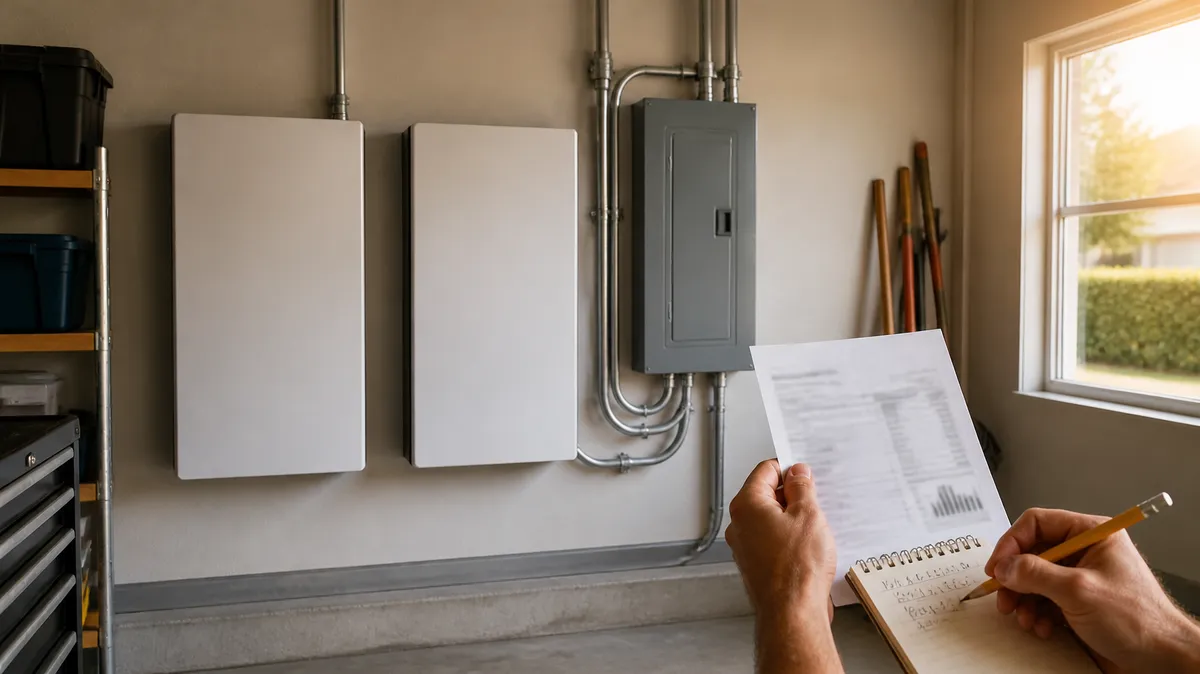
Short answer: a home battery has two limits, and you have to size for both. Energy (kWh) sets how long it lasts; power (kW, plus surge or locked-rotor amps) sets what can run at the same time. For outage backup with no sun, plan usable kWh = daily use × days ÷ 0.9. A typical essentials list (fridge, freezer, sump pump, Wi-Fi, TV, laptop, fan, CPAP) is about 4.1 kWh a day → 4.5 kWh of battery per day. The average U.S. home used about 28.4 kWh a day in 2024 (EIA), so whole-home backup is about 32 kWh per day, roughly two Powerwall-class batteries for one sunless day.
This guide is about permanently installed home batteries tied into your electrical panel. For a cabin or RV that lives off-grid, see the off-grid cabin and RV solar guides; for a plug-in power station, start with the 1-day essentials page. If you haven't sized the panels yet, how many solar panels do I need covers that side.
First, decide what the battery is for
- Outage backup. Size for the loads you'll keep on and how many days you want to ride through. This guide spends most of its time here.
- Time-of-use or export-credit savings. Size for the kWh you use in the expensive evening window, not for outages. Under export-credit tariffs such as California's Net Billing Tariff (CPUC), the battery stores midday solar for the evening instead of exporting it cheaply. Pull hourly data from your utility account to see your evening kWh; a battery larger than that sits partly unused most days. For the dollars, see home battery payback on time-of-use rates.
- Off-grid. Size for the worst month, with several days of autonomy. That is a different problem with a much bigger battery; see the cabin guide.
Most people want a mix of the first two. A battery sized for evening shifting usually covers an essentials-only outage too. The reverse is not always true.
Step 1: total the kWh you'll actually run
Here is the essentials list we use across SolarSized. The figures come from ENERGY STAR listings and manufacturer specs; hours of use are our stated assumptions, so swap in your own.
| Essential load | Wh per day | Basis |
|---|---|---|
| A full-size refrigerator | 912 | 38 W annual-average draw × 24 h (source) |
| A chest freezer | 550 | 22.9 W annual-average draw × 24 h (source) |
| A sump pump | 1,116 | 1115.5 W × 1 h/day (assumed use) (source) |
| A Wi-Fi router | 209 | 8.7 W × 24 h/day (assumed use) (source) |
| A 55-inch TV | 384 | 76.9 W × 5 h/day (assumed use) (source) |
| A laptop | 360 | 60 W × 6 h/day (assumed use) (source) |
| A ceiling fan | 100 | 12.5 W × 8 h/day (assumed use) (source) |
| A CPAP | 449 | 56.1 W × 8 h/day (assumed use) (source) |
| Total | 4,080 | Same list as our 1-day essentials page |
Your fridge and freezer will differ; the ENERGY STAR label's kWh per year ÷ 365 is the honest number. Things that blow up the total: central AC and heat pumps, electric resistance heat, electric water heaters, electric ranges and dryers, well pumps, and EV charging. A single ENERGY STAR window unit running 8 hours adds about 4.3 kWh a day (ENERGY STAR), more than the rest of the list combined.
Step 2: kWh for the days you want covered
Usable kWh = daily kWh × days ÷ 0.9. The 0.9 is our planning margin, not a spec. Rated round-trip efficiency for these batteries is 89–90%, but Enphase's own white paper describes a homeowner whose real-world figure was 84–86% once idle and low-power losses were counted (Enphase). The battery also never delivers its last few percent if the system holds a reserve. Datasheet capacities are already usable figures, so no extra depth-of-discharge cut is needed for these LFP and lithium-ion systems; that's different from lead-acid (see battery chemistry). Our portable power-station pages divide by 0.9 twice (5.04 kWh for a day of essentials on the 1-day page) because those batteries are rated in DC nameplate capacity, before depth-of-discharge and inverter losses.
Below: battery needed for each scenario with no solar recharge, and how many units of each product that takes (rounded up).
| Scenario | Use per day | 1 day, no sun | 2 days | 3 days |
|---|---|---|---|---|
| Essentials only fridge, chest freezer, sump pump (1 h), Wi-Fi, TV, laptop, ceiling fan, CPAP | 4.1 kWh | 4.5 kWh 1× IQ 5P · 1× Powerwall 3 · 1× aPower 2 | 9.1 kWh 2× IQ 5P · 1× Powerwall 3 · 1× aPower 2 | 13.6 kWh 3× IQ 5P · 2× Powerwall 3 · 1× aPower 2 |
| Essentials + one window AC the list above plus an ENERGY STAR window AC 8 h a day | 8.3 kWh | 9.3 kWh 2× IQ 5P · 1× Powerwall 3 · 1× aPower 2 | 18.5 kWh 4× IQ 5P · 2× Powerwall 3 · 2× aPower 2 | 27.8 kWh 6× IQ 5P · 3× Powerwall 3 · 2× aPower 2 |
| Half the average home an illustrative partial-home or critical-loads panel (our example, not a measured average) | 14.2 kWh | 15.8 kWh 4× IQ 5P · 2× Powerwall 3 · 2× aPower 2 | 31.5 kWh 7× IQ 5P · 3× Powerwall 3 · 3× aPower 2 | 47.3 kWh 10× IQ 5P · 4× Powerwall 3 · 4× aPower 2 |
| Average whole home EIA 2024 U.S. average residential use | 28.4 kWh | 31.5 kWh 7× IQ 5P · 3× Powerwall 3 · 3× aPower 2 | 63.1 kWh 13× IQ 5P · 5× Powerwall 3 · 5× aPower 2 | 94.6 kWh 19× IQ 5P · 8× Powerwall 3 · 7× aPower 2 |
Essentials and window-AC loads from the table above (ENERGY STAR, ResMed, Zoeller, TP-Link, Apple specs with our hours of use). Average home: EIA 2024 U.S. average of 863 kWh a month (EIA). Unit counts: 5.0 kWh (IQ 5P), 13.5 kWh (Powerwall 3 or Powerwall 3 + Expansion units), 15 kWh (aPower 2), from the datasheets below. A product's maximum system size can cap the 3-day whole-home column.
Step 3: check power and motor starts
The kWh table says nothing about whether the battery can run your loads. Add the running watts of everything that might be on at once and compare it with continuous kW. Then find the hardest motor start, usually the central AC compressor or a well pump, and compare its locked-rotor amps (LRA), printed on the condenser or pump nameplate, with the battery's rating.
| Tesla Powerwall 3 | FranklinWH aPower 2 | Enphase IQ Battery 5P | |
|---|---|---|---|
| Usable energy | 13.5 kWh (AC) | 15 kWh | 5.0 kWh |
| Continuous power | 11.5 kW | 10 kW (11.5 kVA) | 3.84 kVA |
| Short-term peak | — | 15 kW for 10 s | 7.68 kW for 3 s; 6.14 kW for 10 s |
| Motor start (locked-rotor amps) | 185 A LRA | 185 A LRA | up to 48 A LRA |
| Round-trip efficiency (rated) | 89% solar-to-battery-to-home | 90% | 90% AC (96% DC) |
| Max charge rate | 5 kW (8 kW with expansions) | 8 kW | — |
| Expansion | up to 4 Powerwall 3 + 3 Expansion units | up to 15 units (225 kWh) per aGate | add units (5 kWh each) |
| Warranty | 10 years | 15 years or 60 MWh | 15 years or 6,000 cycles |
| Datasheet | Tesla | FranklinWH | Enphase |
Figures from each maker's North American datasheet as of October 26, 2026; FranklinWH's 5-ton AC claim is from its own materials. Ratings change between revisions, so check the current datasheet before you buy. Tesla's Expansion unit adds 13.5 kWh but no extra inverter, so it raises runtime, not continuous power.
Three things stand out. One IQ 5P (48 A LRA) is an essentials battery; units are stacked for more power and energy. Powerwall 3 and aPower 2 both list 185 A, which is enough for many residential AC compressors, but verify yours. And energy, not power, is what limits most whole-home plans: a central AC that starts fine will still use a large share of one battery's kWh if it runs for hours.
Step 4: count on solar refills, but not too much
With a backup-capable system, panels refill the battery each day of an outage. How much depends heavily on the month. We pulled PVWatts v8 monthly output for a 1 kW fixed array (30° tilt, south-facing, default losses) in six cities (PVWatts):
| City | Worst month, kWh per kW per day | Best month | 8 kW array, worst-month day | Array to refill essentials daily | Array to refill average home daily |
|---|---|---|---|---|---|
| Detroit, MI | 1.84 (Dec) | 4.72 (Jul) | 14.7 kWh | 2.5 kW | 17.1 kW |
| Seattle, WA | 1.20 (Dec) | 4.64 (Aug) | 9.6 kWh | 3.8 kW | 26.3 kW |
| Houston, TX | 3.01 (Dec) | 4.22 (Jul) | 24.1 kWh | 1.5 kW | 10.5 kW |
| Phoenix, AZ | 4.22 (Jan) | 5.65 (Apr) | 33.8 kWh | 1.1 kW | 7.5 kW |
| Tampa, FL | 3.79 (Jul) | 4.93 (Mar) | 30.3 kWh | 1.2 kW | 8.3 kW |
| Denver, CO | 3.54 (Dec) | 5.06 (Jun) | 28.3 kWh | 1.3 kW | 8.9 kW |
Worked example: Detroit in December, essentials only. An 8 kW array makes about 14.7 kWh on an average December day, more than the 4.5 kWh essentials need, so in theory the battery tops up daily. In practice outage weather is often worse than average: ice storms, snow on the panels, and stretches of overcast days. So plan the battery to cover at least one or two days with no sun (the Step 2 table), and treat solar as the thing that lets you get through longer outages. For a whole home, the same Detroit array covers only about 47% of an average day in December; Phoenix's worst month (January) is far kinder at 4.2 kWh per kW.
Also check the battery's charge limit. Powerwall 3 charges at up to 5 kW alone (8 kW with expansions) and aPower 2 at 8 kW, so a big array can't refill them faster than that (Tesla, FranklinWH). A grid-tied system without a battery or backup switching shuts down in an outage; see grid-tie vs backup.
Worked example: a 2-day essentials plan
Load: 4.1 kWh a day. Two days without sun: 4.1 × 2 ÷ 0.9 = 9.1 kWh usable. That's one Powerwall 3 or one aPower 2, or 2 IQ 5P units. Power check: the biggest motor on the list is the sump pump, a 1,116 W Zoeller M53 (Zoeller); Zoeller doesn't publish its starting current, so have the installer confirm it, especially on a single IQ 5P with its 48 A LRA limit. Add an 8 kW array and, outside deep winter, the battery refills most days.
Safety, installation and incentives
- Use a licensed installer. Home batteries connect to your service panel, need a permit and inspection in most places, and the backup switching has to isolate your house from the grid so line workers aren't energized by your system. Ask for equipment listed to UL 9540; Tesla lists UL 9540 for Powerwall 3 (datasheet).
- Critical-loads panel vs whole-home backup. Moving essentials to a separate backed-up subpanel lets a smaller battery cover them without the risk of the dryer draining it. Whole-home backup is simpler to live with but needs more kW and kWh.
- Medical equipment. If someone depends on a CPAP, oxygen concentrator or refrigerated medication, plan with their doctor and supplier, and keep a backup that doesn't depend on any one battery. This page is not medical advice.
- Federal credit. The IRS says the 30% Residential Clean Energy Credit (Section 25D), which covered battery storage, is not available for expenditures made after December 31, 2025 (IRS). Search your ZIP in DSIRE for state and utility battery programs.
Measure your loads first
The cheapest sizing tool is a meter. A plug-in watt meter gives the real daily Wh of a fridge or freezer; a whole-home energy monitor shows your evening and peak loads so you size the battery from data instead of guesses. If a full home battery is more than you need, a portable power station can cover a short essentials list (see our 1-day and 3-day pages, or power stations for home backup on our sister site).
As an Amazon Associate we earn from qualifying purchases.
Plug-in watt metersWhole-home energy monitorsLiFePO4 power stations
Questions
How many kWh of battery do I need to power a house?
For one day with no solar, the usable kWh should be your daily use divided by about 0.9 to cover idle losses and reserve. The average U.S. home bought about 28.4 kWh a day in 2024 (EIA), so whole-home backup is about 32 kWh per day; an essentials-only list of fridge, freezer, sump pump, Wi-Fi, TV, laptop, fan and CPAP is about 4.5 kWh per day.
How long will a 13.5 kWh battery last in an outage?
At our essentials load of about 4.1 kWh a day, roughly 3.0 days with no solar recharge, after a 10% allowance for idle losses and reserve. At the average home use of 28.4 kWh a day, about 10 hours. Solar recharge in daylight can stretch either figure.
Can a home battery run central air conditioning?
Often, if the battery can supply the compressor's starting current. Compare the locked-rotor amps (LRA) on your condenser nameplate with the battery's rating: Tesla lists 185 A LRA for Powerwall 3, FranklinWH lists 185 A for aPower 2 and says it can start a 5-ton AC, and Enphase lists up to 48 A LRA for one IQ Battery 5P. Energy is the other limit: central AC can use more kWh in a day than a single battery holds.
Is one Powerwall enough?
For essentials, yes: 13.5 kWh covers about 3.0 days of our essentials list. For a whole home at average use, one unit covers well under a day without sun, and its 11.5 kW continuous limit means big loads such as an electric range, dryer and AC can't all run at once.
Do batteries lose energy just sitting there?
Yes. Rated round-trip efficiency is 89–90% for these three systems, but Enphase's own white paper describes an owner whose real-world figure was 84–86% because of idle and low-power losses. That is why this guide adds a 10% planning margin.
Will my solar panels charge the battery during an outage?
Only if the system is designed for backup. A standard grid-tied inverter shuts off when the grid is down; a battery system with backup switching keeps the array running and recharging the battery. In winter the recharge can be small: a 1 kW array makes about 1.8 kWh a day in a typical Detroit December (PVWatts).
Is there a federal tax credit for home batteries in 2026?
Not under Section 25D. The IRS says the Residential Clean Energy Credit, which covered battery storage, is not available for expenditures made after December 31, 2025. Check state, local and utility programs in DSIRE.
Sources
- Tesla, Powerwall 3 datasheet (North America)
- FranklinWH, aPower 2 datasheet
- Enphase, IQ Battery 5P datasheet; Battery efficiency demystified: round-trip efficiency vs real-world performance
- U.S. EIA, Today in Energy: 2024 residential electricity use and bills
- NLR (formerly NREL), PVWatts v8, monthly AC output for a 1 kW array, queried October 25, 2026
- Load data: ENERGY STAR refrigerator and room AC listings, ResMed AirSense 11 user guide, Zoeller M53; full list on each appliance page
- IRS, Residential Clean Energy Credit; CPUC, Net Energy Metering and Net Billing; DSIRE